
1.High-Linearity, High-Efficiency Millimeter-Wave Power Amplifiers
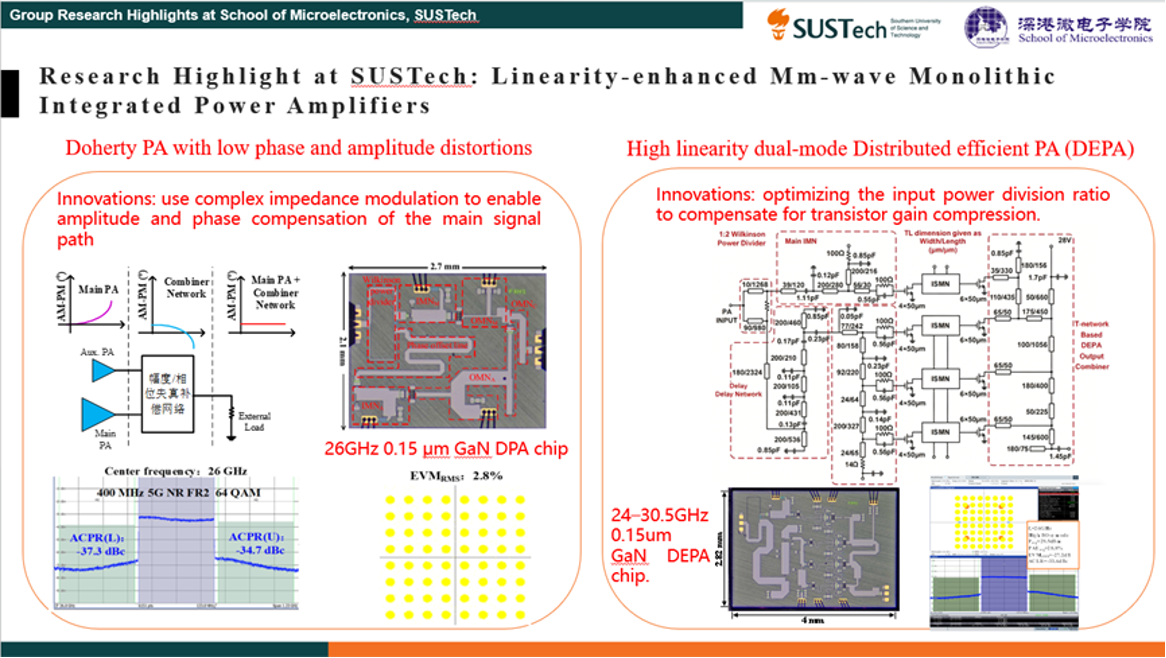
In future Beyond-5G (B5G) and next-generation wireless communicationsystems, complex modulation techniques (such as high-order QAM) generate signals with high peak-t8o-average power ratios (PAPR), placing stringent demands on RF transmitters. Achieving high efficiency at power back-off, wideband operation, and excellent linearity (reducing AM-AM and AM-PM distortions) simultaneously has long been a challenge for millimeter-wave power amplifier (PA) design. Load modulation-based amplifiers, such as the Doherty power amplifier (DPA), offer a great balance in meeting these rigorous system requirements.During his time as a graduate student and postdoctoral researcher prior to2022, Dr. Fang pioneered design methodologies to improve DPA linearity through the output combining network. He proposed an innovative method to synthesize predefined AM-PM characteristics to compensate for the main transistor's phase distortion, demonstrating a highly linear DPA for 4.7-5.3 GHz without the need for digital predistortion (DPD). His early work also included a 28 GHz beamforming Doherty power amplifier (B-DPA) implemented in 45-nm SOI-CMOS technology. By incorporating dual digitally assisted vector multipliers, this architecture eliminated phase-shift offsets and enabled a wide range of phase adjustments alongside high back-off efficiency, all while maintaining excellent AM-PM characteristics.
At the Southern University of Science and Technology (SUSTech), our grouphas continued the work exploring various aspects of the design and implementation of novel, highly efficient millimeter-wave amplifiers. We have proposed a new method to independently and flexibly manipulate the amplitude and phase distortions of the output combining network, demonstrating a 0.15 µm GaN-on-SiC millimeter-wave DPA with ultra-low AM-AM (<1 dB) and AM-PM (<3°) distortions over the 25-26.5 GHz band. Furthermore, to overcome the limitations of traditional architectures, we have introduced an asymmetrical input power splitting technique to significantly enhance the bandwidth and gain, and developed a novel distributed efficient power amplifier (DEPA) based on a bandpass T-structure unit network. This wideband DEPA supports dual operation modes ("high back-off efficiency" and "enhanced-bandwidth"), achieving an outstanding balance of efficiency, linearity, and bandwidth over 24-30.5 GHz with excellent EVM performance without relying on DPD.
Reference:
- X. Fang*, W. Daiand J. Shi, "A Linear and Wideband GaN MMIC Distributed Efficient Power Amplifier Design Using Unequal Power Splitting and Bandpass Unit Network," in IEEE Transactions on Microwave Theory and Techniques, doi: 10.1109/TMTT.2024.3480451.
- X. Fang*,J. Shi, C. Wei, Y. Duan, P. Li and Z. Wang, "A Linear Millimeter-Wave GaN MMIC Doherty Power Amplifier With Improved AM-AM and AM-PM Characteristics," IEEETransactions on Microwave Theory and Techniques, early access,doi: 10.1109/TMTT.2023.3349206.
- J. Shi,X. Fang*, Q. Zhang, H. Yu and H. Wang, "Theoretical Analysis andExperimental Validation of Enhancing Doherty Amplifier Gain via Asymmetrical Input Power Splitting," 2024 IEEE MTT-S International Wireless Symposium (IWS), Beijing, China, 2024, pp. 1-3, doi: 10.1109/IWS61525.2024.10713545.
- X. Fang, J. Xia*, and S. Boumaiza, "A 28-GHz beamformingDoherty power amplifier with enhanced AM-PM characteristic," IEEE Trans. Microw. Theory Techn. vol. 68, no. 7,3017-3027, Jun. 2020.
- X. Fang*, A. Cheng and S.Boumaiza, "Linearity enhanced Doherty power amplifier using output combining network with pre-defined AM-PM characteristic," IEEE Trans. Microw. Theory Techn.. vol. 67, no. 1, 195-204, Jan. 2019.
2.Design and Research of BroadbandMillimeter-Wave RF Front-End Integrated Circuits
Millimeter-wave RF front-end circuits playa crucial role in future high-speed, large-bandwidth wireless communication systems, such as 5G and satellite communications. However, limited by the parasitic effects and finite cutoff frequencies of semiconductor technologies (e.g., GaN) at high frequencies, achieving ultra-wide bandwidth, low insertion loss, high isolation, and high efficiency simultaneously has long been a major challenge for both academia and industry. Innovative broadband matching and network topology designs offer a great balance to break through these technical bottlenecks and realize high-performance millimeter-wave front-end integrated circuits.
Since Dr. Fang joined the SouthernUniversity of Science and Technology (SUSTech) and established the research group, our team has conducted in-depth research in the field of broadband millimeter-wave RF front-end chips. It should be emphasized that all the core work and achievements presented here were completed entirely after Dr. Fang founded the group. In the area of RF switches, we proposed a compact GaN single-pole double-throw (SPDT) switch design method based on modified π-networks. By absorbing the parasitic inductance of the isolation path
directly into the matching network, we achieved an insertion loss of less than 2.1 dB and an isolation of greater than 42 dB over the 10-28 GHz band.
Furthermore, to address high-frequency limitations, we developed a switchn architecture based on a bandpass matching network (BMN). We successfully demonstrated an ultra-wideband single-pole single-throw (SPST) switch operating across the 15-40 GHz band with an insertion loss below 2 dB and an isolation greater than 33 dB, significantly enhancing the high-frequency and high-power handling capabilities of the devices.
At SUSTech, our group has continued toexpand our research exploring various aspects of the design and fabrication of novel RF front-end circuits. In the field of power amplifiers (PAs), we introduced a novel wideband matching circuit structure that effectively compensates for parasitic capacitance under high drain bias and controls the second harmonic, achieving a peak power-added efficiency (PAE) of up to 42.8% in the 24.5-29 GHz band. Meanwhile, for low-noise amplifiers (LNAs), we proposed and applied a multi-stage inductive feedback compensation loop (FCL) technique. The demonstrated 10-30 GHz broadband GaN LNA achieves an ultra-low noise figure of 2.1-3.4 dB while exhibiting excellent gain flatness and outstanding linearity. These systematic research achievements provide strong technical support for future frequency-agile wireless systems.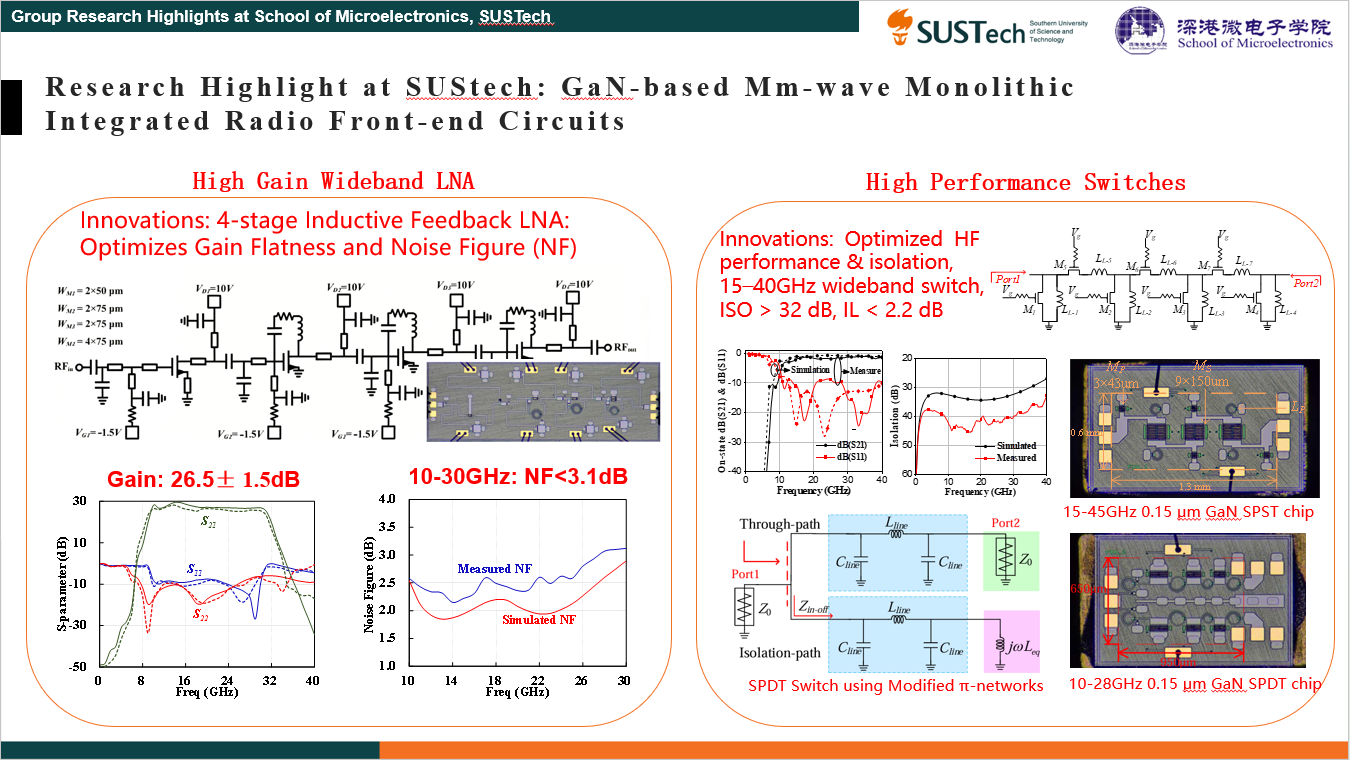
Reference:
- C. Wang and X. Fang*, "Design of a Wideband and High Isolation Millimeter-Wave GaN Monolithic Integrated Switch Using Bandpass Matching Network," in IEEE Journal of Microwaves, doi: 10.1109/JMW.2025.3649639.
- C. Wang, Q. Pan and X. Fang*, "A Broadband and Compact GaN Millimeter-Wave MMIC SPDT Switch Using Modified π-Networks," in IEEE Solid-State Circuits Letters, vol. 9, pp. 21-24, 2026, doi: 10.1109/LSSC.2025.3646815.
- W. Huang and X. Fang*, "Design and Analysis of a Millimeter-Wave Wideband GaN LNA With Inductive Feedback Network," in IEEE Microwave and Wireless Technology Letters, doi: 10.1109/LMWT.2025.3631687.
- J. Shi, X. Fang*, H. Yu, J. Sui and K. -K. M. Cheng, "Novel Wideband Millimeter-Wave GaN Power Amplifier Design Using Transistors With Large Drain Capacitance and High Optimum Load Impedance," IEEE Transactions on Circuits and Systems II: Express Briefs, vol. 70, no. 12, pp. 4309-4313, Dec. 2023. DOI: 10.1109/TCSII.2023.3291383
- W. Huang, X. Fang*, W. Lin, G. Huang, X. Wang and L. Zhao, "A Wideband Millimeter-Wave GaN Low-Noise Amplifier Using Multi-Stage Feedback Compensation," 2023 IEEE MTT-S International Microwave Workshop Series on Advanced Materials and Processes for RF and THz Applications (IMWS-AMP), Chengdu, China, 2023, pp. 1-3, doi: 10.1109/IMWS-AMP57814.2023.10381036.
3. Ultra-Wideband Load-Modulated Power Amplifier Architectures
The endless pursuit of high-speed wireless data transmission drives modern communication systems to adopt modulation schemes with high spectral efficiency and large peak-to-average power ratios (PAPR). This requires base station power amplifiers (PAs) to support the efficient amplification of high-PAPR signals over extremely wide operating frequency bands. However, traditional Doherty power amplifiers (DPAs) have long faced a severe efficiency-bandwidth trade-off limitation due to the narrowband nature of their quarter-wavelength impedance transformers. Consequently, achieving wideband performance while maintaining broad power back-off efficiency enhancement has always been a major challenge in the design and implementation of ultra-wideband load-modulated PAs.
During his Ph.D. and postdoctoral studies, Dr. Fang pioneered fundamental research addressing the bandwidth limitations of broadband DPAs. He introduced a design strategy utilizing a frequency-varying complex combining load (CCL) and an input current control strategy, which effectively extended the bandwidth and high-efficiency range of the DPA. His subsequent work incorporated a bandpass auxiliary transformer, maintaining wideband Doherty behavior while improving the power utilization factor (PUF) to 0.9 and achieving a 6-dB back-off efficiency of 55%-64% across the 1.6-2.4 GHz band. Furthermore, by optimizing the peak combining current ratio, he modified the DPA architecture to extend its output back-off (OBO) range to 9 dB, achieving a peak power of approximately 42 dBm over a wide 1.35-2.05 GHz bandwidth.
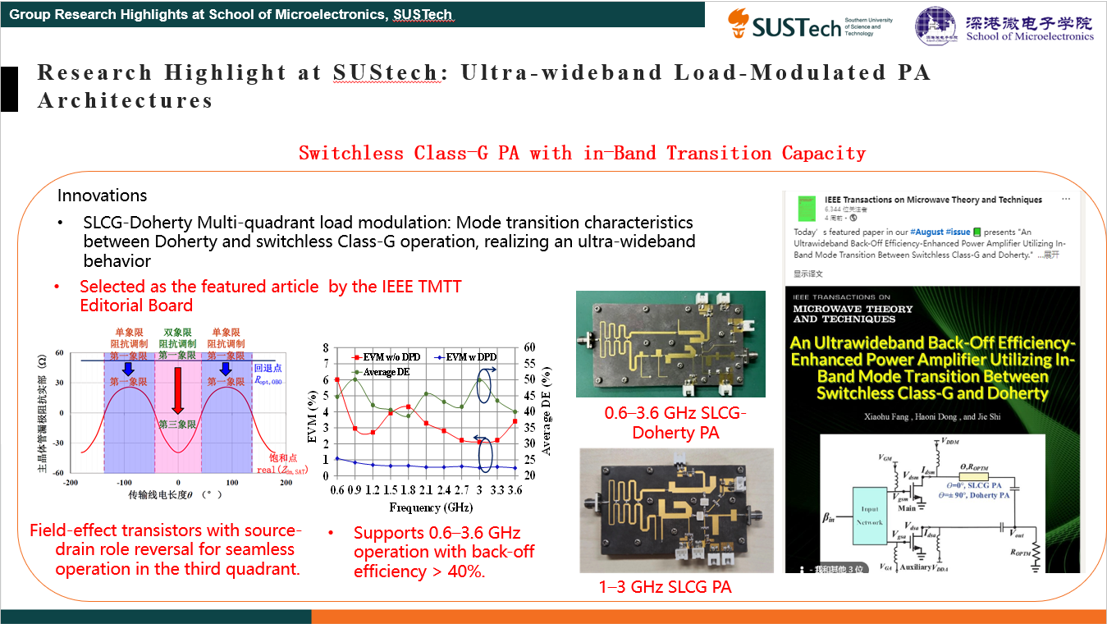
At Southern University of Science and Technology (SUSTech), our group has continued exploring various aspects of the design and implementation of novel ultra-wideband efficiency-enhanced power amplifiers. We have developed a comprehensive theory for switchless Class-G (SLCG) PAs and proposed a new design method that successfully absorbs package parasitics, enabling commercial packaged transistors to operate in a high-efficiency SLCG mode over a wide 1-3 GHz band, achieving a drain efficiency of 39.2%-49.1% at a 7.5-dB power back-off. More recently, we have also proposed a novel ultra-wideband hybrid SLCG-DPA architecture that overcomes the fundamental bandwidth limitations caused by matching network phase shifts through a seamless mode transition between SLCG and Doherty operations. Based on this theory, we demonstrated a 0.6 to 3.6 GHz ultra-wideband PA, showing an excellent drain efficiency of 40%-57% at 7.5-dB back-off across the entire six-octave measurement band.
Reference:
- X. Fang*, H. Dong and J. Shi, "An Ultrawideband Back-Off Efficiency-Enhanced Power Amplifier Utilizing In-Band Mode Transition Between Switchless Class-G and Doherty," in IEEE Transactions on Microwave Theory and Techniques, early access. doi: 10.1109/TMTT.2025.3540876
- X. Fang*, R. Chen and J. Shi, "Switchless Class-G Power Amplifiers: Generic Theory and Design Methodology Using Packaged Transistors," IEEE Transactions on Microwave Theory and Techniques, early access, doi: 10.1109/TMTT.2024.3351852.
- X. Fang*, H. Liu, K. M. Cheng, S. Boumaiza, "Modified Doherty amplifier with extended bandwidth and back-off power range using optimized combining currents," IEEE Trans. Microw. Theory Techn., vol. 66, no. 12, 5347-5357, Dec. 2018.
- X. Fang* and K. M. Cheng, "Broadband, wide efficiency range, Doherty amplifier design using frequency-varying complex combining load", IEEE MTT-S 2015 Int. Microw. Symp. Dig., USA, May, 2015.
- X. Fang*, K. M. Cheng, "Improving power utilization factor of broadband Doherty amplifier by using band-pass auxiliary transformer," IEEE Trans. Microw. Theory Techn., vol. 63, no. 9, 2811-2820, Sep. 2015.
 粤公网安备44030002015015号